Cyber Security Courses After 12th: Complete Career Guide for Students
In today’s digital age, the importance of cybersecurity has skyrocketed. With increasing threats to personal, corporate, and government data, there is a growing demand for professionals who can safeguard sensitive information. This makes cybersecurity one of the most promising and lucrative career paths for students after completing 12th grade. If you’re considering a career in this field, this guide will take you through the top cyber security courses after 12th, offering a detailed breakdown of what to expect, the eligibility criteria, and career opportunities.
What is Cyber Security?
Cybersecurity involves protecting computer systems, networks, and data from digital attacks, theft, and other threats. The goal is to ensure that information remains safe and accessible only to authorized users. As the digital world grows, the need for skilled professionals to manage these security protocols becomes even more crucial.
Why Choose Cyber Security After 12th?
Cybersecurity offers various career benefits:
- High Demand for Professionals: As the frequency and severity of cyberattacks increase, companies are seeking experts who can protect their networks and data.
- Lucrative Salaries: Cybersecurity professionals are well-compensated, with salaries that grow as you gain experience and specialization.
- Job Security: With the ever-increasing reliance on digital platforms, cybersecurity is an area where job growth is expected to remain steady for years.
- Diverse Career Opportunities: From ethical hacking to network security, there are several paths you can take within the field.
Now, let’s look at the top cyber security courses after 12th that can help you kickstart your career in this exciting and fast-growing field.
1. B.Tech in Cyber Security
Eligibility: 10+2 with Physics, Chemistry, and Mathematics (PCM)
A B.Tech in Cyber Security is one of the most comprehensive courses you can pursue after 12th if you’re interested in a long-term career in this field. This degree will not only introduce you to the fundamentals of cybersecurity but also provide you with advanced knowledge of networking, cryptography, information security management, and ethical hacking.
Key Subjects Covered: Network security, cryptography, security audits, ethical hacking, and data protection.
Career Opportunities: Network Security Engineer, Information Security Analyst, Ethical Hacker, Cyber Security Consultant.
2. BCA (Bachelor of Computer Applications) with Cyber Security Specialization
Duration: 3 years
In addition, for students who want to enter the world of IT and cybersecurity but prefer a more flexible degree, a BCA with a cybersecurity specialization can be an ideal choice.
The course focuses on programming, computer networks, database management, and cyber law, with specialized subjects related to cyber threats, vulnerabilities, and secure coding.
Key Subjects Covered: Programming, Database management, Networking, and Cyber Law.
Career Opportunities: Cyber Security Analyst, IT Manager, Network Administrator, System Security Manager.
3. Diploma in Cyber Security
Duration: 1-2 years
Eligibility: 10+2
For students who prefer a shorter, more focused course, a Diploma in Cyber Security is an excellent option. This course provides practical training on handling security issues like hacking, malware, and data theft, without the extensive commitment of a full degree. Many technical institutes and universities offer this diploma, which can be a stepping stone to more advanced studies or immediate job placements.
Key Subjects Covered: Network security, Ethical Hacking, Web Security, and Cyber Forensics.
Career Opportunities: Security Analyst, IT Support, Cyber Security Consultant.
4. Certified Ethical Hacking (CEH)
Duration: 3-6 months
Eligibility: No formal degree required, but prior knowledge of networking is recommended.
For those looking to specialize in ethical hacking, the Certified Ethical Hacking (CEH) course is one of the most recognized certifications worldwide. It covers the methods used by hackers to infiltrate systems, which helps security professionals learn how to defend against such attacks.
Key Subjects Covered: Footprinting, network scanning, malware threats, hacking web servers, and penetration testing.
Career Opportunities: Ethical Hacker, Penetration Tester, Security Consultant, Cyber Crime Investigator.
5. B.Sc. in Cyber Security
Duration: 3 years
Eligibility: 10+2 with Science (preferably Physics, Chemistry, and Mathematics)
For students who prefer a scientific approach to cybersecurity, a B.Sc. in Cyber Security is an excellent option. The course covers various aspects of IT security, including the technical, legal, and administrative components required to protect digital infrastructure.
Key Subjects Covered: Cyber Laws, Risk Management, Malware Analysis, and Information Security.
Career Opportunities: Cyber Security Engineer, Information Security Analyst, Risk Management Consultant.
6. M.Sc. in Cyber Security (For Postgraduates)
Duration: 2 years
Eligibility: Graduation in a related field (BCA, B.Tech, etc.)
If you already have a basic understanding of IT or cybersecurity and want to take your knowledge to the next level, pursuing an M.Sc. in Cyber Security can be a good option. This course is designed to build expertise in areas like advanced encryption techniques, network monitoring, and cloud security.
Key Subjects Covered: Advanced Cryptography, Secure Software Development, Cloud Security, and Risk Management.
Career Opportunities: Cyber Security Researcher, Security Architect, Network Security Administrator.
BCA Cyber Security vs B.Tech Cyber Security
| Feature | BCA Cyber Security | B.Tech Cyber Security |
| Duration | 3 Years | 4 Years |
| Focus | Software & Applications | Engineering & Infrastructure |
| Technical Depth | Moderate | Advanced |
| Best For | IT & software careers | Advanced security engineering |
| Eligibility | Any stream in many colleges | PCM compulsory |
| Career Roles | Analyst, Admin | Engineer, Security Architect |
Which One is Better?
- Choose BCA Cyber Security if you prefer software applications, coding, and IT management.
- Choose B.Tech Cyber Security if you want deeper technical knowledge and engineering-focused career roles.
Ethical Hacking vs Cyber Security
| Ethical Hacking | Cyber Security |
| Focuses on finding vulnerabilities | Focuses on complete protection |
| Offensive approach | Defensive + offensive approach |
| Includes penetration testing | Covers networks, cloud, applications, and systems |
| Specialized field | Broad industry domain |
Main Difference
Ethical hacking is a part of cyber security. Cyber security includes multiple areas like cloud security, digital forensics, compliance, incident response, and threat analysis.
Diploma vs Degree in Cyber Security
| Diploma | Degree |
| Short-term course | Long-term academic program |
| Faster job entry | Better career growth |
| Practical-focused | Theory + practical learning |
| Lower cost | Higher investment |
| Suitable for beginners | Suitable for advanced career goals |
Which Should You Choose?
- A diploma is good for skill-based quick learning.
- A degree offers stronger long-term career opportunities and higher-level roles.
7. Online Cyber Security Courses
Duration: Varies (from a few weeks to a year)
Additionally, many online platforms, such as Coursera, Udemy, and edX, offer cyber security courses that can be taken from the comfort of your home. These courses are perfect for those looking to learn at their own pace, whether it’s a general introduction to cyber security or a specialized course in ethical hacking or network defense.
Key Subjects Covered: Basic Cyber Security, Ethical Hacking, Malware Analysis, and Digital Forensics.
Career Opportunities: Cyber Security Specialist, Network Security Engineer, Information Security Consultant.
Cyber Security Course Fees After 12th in India (2026)
Course fees are the first thing most students and parents check. Below is a realistic fee range for every cyber security course you can join after 12th in India, along with what you can expect to pay at private institutes in Bangalore.
Course | Duration | Fees (India Average) | Bangalore Private Range |
B.Tech Cyber Security | 4 Years | ₹4,00,000 – ₹16,00,000 | ₹8,00,000 – ₹20,00,000 |
B.Sc Cyber Security | 3 Years | ₹1,50,000 – ₹6,00,000 | ₹2,00,000 – ₹5,00,000 |
BCA Cyber Security | 3 Years | ₹1,50,000 – ₹5,00,000 | ₹2,00,000 – ₹6,00,000 |
Diploma in Cyber Security | 1 – 2 Years | ₹40,000 – ₹1,50,000 | ₹50,000 – ₹1,20,000 |
CEH (Certified Ethical Hacker) | 3 – 6 Months | ₹40,000 – ₹90,000 | ₹45,000 – ₹75,000 |
CompTIA Security+ | 2 – 3 Months | ₹25,000 – ₹50,000 | ₹30,000 – ₹55,000 |
CCNA (Networking Foundation) | 2 – 3 Months | ₹20,000 – ₹45,000 | ₹25,000 – ₹40,000 |
Network + Cyber Security Combo | 6 – 8 Months | ₹50,000 – ₹1,20,000 | Contact NetworkersChamp |
Fees updated July 2026. Actual fees vary by college, city and batch type. Always confirm the current fee structure directly with the institute before enrolling.
What Affects the Fees?
- College type: Government colleges charge far less than private universities for the same B.Tech or B.Sc degree.
- Lab access: Institutes that give real device and rack access charge more than theory-only or recorded-video courses. This is where practical skill actually comes from.
- Exam voucher: Certification fees like CEH and CompTIA include an exam voucher. Check whether the quoted price covers the exam or only the training.
- Batch type: Weekend and fast-track batches are usually priced slightly higher than regular weekday batches.
Cyber Security Salary in India After 12th (2026)
Salary depends more on your certifications and hands-on lab experience than on your degree alone. Here is what cyber security roles pay across India in 2026.
Job Role | Fresher | 3 – 5 Years | 8+ Years |
SOC Analyst (L1) | ₹3 – 5 LPA | ₹8 – 12 LPA | ₹18 – 25 LPA |
Network Security Engineer | ₹4 – 6 LPA | ₹10 – 15 LPA | ₹22 – 35 LPA |
Penetration Tester | ₹4 – 7 LPA | ₹12 – 18 LPA | ₹25 – 40 LPA |
Cloud Security Engineer | ₹5 – 8 LPA | ₹14 – 20 LPA | ₹30 – 45 LPA |
Firewall / Security Admin | ₹3.5 – 6 LPA | ₹9 – 14 LPA | ₹20 – 30 LPA |
Security Architect | — | ₹18 – 25 LPA | ₹40 – 60 LPA |
Bangalore pays roughly 15–20% above the national average for cyber security roles, because the city holds the largest concentration of security operations centres, product companies and IT service headquarters in India. A fresher who would earn ₹4 LPA elsewhere often starts closer to ₹5 LPA in Bangalore.
One thing to be clear about: a degree alone rarely gets you the higher end of these ranges. Candidates who clear CCNA and then a security certification, with real lab hours behind them, consistently get better offers than those with only academic marks.
Degree vs Certification: Which Route Should You Take After 12th?
This is the single biggest decision after 12th. Most students think it is one or the other. It is not.
Factor | Degree Route | Certification Route |
Time to first job | 3 – 4 years | 6 – 9 months |
Total cost | ₹1.5 L – ₹16 L | ₹60,000 – ₹1.5 L |
Starting salary | ₹4 – 6 LPA | ₹3 – 5 LPA |
Eligibility | B.Tech needs PCM | Open to all streams |
Practical exposure | Limited lab time | Heavy hands-on lab work |
Needed for MNC / abroad | Usually required | Supporting credential |
Best for | Long-term growth, higher management roles | Fast job entry, skill-based hiring |
The Smartest Option: Do Both
The strongest combination is to enrol in a degree and complete networking and security certifications alongside it. Students who finish CCNA in their first year and a security certification by their third year graduate with both a degree and a job-ready skill set. They clear interviews far more easily than classmates who only have academic marks.
If a degree is not affordable or not the right fit, the certification route on its own is completely valid. Cyber security is one of the few fields in India where hiring managers test practical skill before checking the degree certificate.
Cyber Security Courses After 12th Without Maths
A very common worry: “I did not take Mathematics in 12th, can I still enter cyber security?” The answer is yes, for almost every path except B.Tech.
Course | Maths Required? | Who Can Apply |
B.Tech Cyber Security | Yes (PCM compulsory) | Science stream only |
B.Sc Cyber Security | Usually not | Science stream, many colleges accept without Maths |
BCA Cyber Security | No (most colleges) | Any stream |
Diploma in Cyber Security | No | Any stream |
CCNA / CEH / Security+ | No | Any stream, no degree needed |
Cyber security work is about understanding how networks and systems behave, spotting unusual patterns, and applying tools correctly. Basic arithmetic and logical thinking are enough for entry-level roles. Advanced cryptography research needs mathematics, but that is a specialised area most professionals never enter.
Can Commerce and Arts Students Do Cyber Security After 12th?
Yes. This is one of the few technical fields in India that genuinely opens up to non-science students.
Commerce students can join BCA Cyber Security, diploma programs, or go straight into certification training. Commerce backgrounds are actually an advantage in areas like compliance, risk management, audit and governance – where understanding business processes matters as much as technical skill. Banking and fintech companies actively hire for these roles.
Arts students can take the same routes. Many colleges accept any stream for BCA. Certification tracks such as CCNA, CompTIA Security+ and CEH have no stream restriction at all.
What matters is your starting point. If you are from a non-technical stream, begin with networking fundamentals before jumping into hacking tools. Trying to learn penetration testing without understanding how a network works is the most common mistake we see, and it wastes months.
12-Month Cyber Security Study Roadmap After 12th
If you want the fastest realistic path from 12th to a first job, this is the sequence that works. Each stage builds on the previous one.
Stage | Months | What You Learn | Certification Target |
1. Foundation | 1 – 3 | Networking basics, IP addressing, routing, switching, TCP/IP | |
2. Security Base | 4 – 6 | Linux, security fundamentals, cryptography basics, access control | |
3. Offensive Skills | 7 – 9 | Ethical hacking, penetration testing, Kali Linux, vulnerability assessment | |
4. Specialisation | 10 – 12 | Firewall administration or cloud security, depending on your target role |
Why Start With Networking?
Cyber security is built on top of networking. Firewalls, intrusion detection, SOC monitoring, penetration testing – all of it assumes you already understand how packets move, how routing works, and what normal traffic looks like. Students who skip this stage struggle badly in interviews when asked basic troubleshooting questions.
Start with CCNA, then move into security. It adds three months at the start and saves you a year of confusion later.
Cyber Security Courses in Bangalore After 12th
Bangalore is the strongest city in India to start a cyber security career, and the reason is simple: this is where the jobs are.
Why Bangalore
- Largest security job market in India – the city hosts the highest number of security operations centres and network security teams in the country.
- Product and service companies together – global product companies, IT service majors and a large startup ecosystem all hire security freshers.
- Faster fresher hiring – entry-level SOC and network security openings appear more frequently here than in any other Indian city.
- Better salary bands – packages run about 15–20% above the national average for the same role.
Main Training and Job Hubs in Bangalore
Most cyber security and networking training institutes are concentrated around Marathahalli, Whitefield, Electronic City, BTM Layout, Koramangala and Bellandur. These are also the areas where the hiring companies sit, which makes interview travel and walk-ins far easier.
Training at NetworkersChamp
NetworkersChamp has trained networking and security professionals in Bangalore since 2009, from our centre on Marathahalli Ring Road.
- CCIE-certified trainers – you learn from engineers who have cleared the highest level Cisco certification and worked on live enterprise networks.
- Real device labs, not simulators – you configure actual routers, switches and firewalls. Simulator-only training does not prepare you for real troubleshooting.
- 24/7 rack access – practise whenever you want, including after batch hours. Lab hours are what separate a certified candidate from a hired one.
- Classroom and live online batches – weekday, weekend and fast-track options.
- Placement support – interview preparation, resume guidance and access to our hiring network. See our placement details.
To discuss which course suits your background, visit our cyber security training in Bangalore page or contact our training advisors for a free counselling call.
Online vs Classroom Cyber Security Training
Both work. What matters is whether the training is live and whether you get lab access.
Factor | Live Online | Classroom | Recorded Video Only |
Trainer interaction | Yes, real time | Yes, in person | None |
Doubt clearing | Immediate | Immediate | Forum or none |
Lab access | Remote rack access | Physical + remote | Rarely included |
Peer learning | Moderate | High | None |
Completion rate | High | High | Very low |
Placement support | Usually yes | Usually yes | No |
Best for | Students outside Bangalore | Students in Bangalore | Revision only |
Recorded-only courses are cheap, and that is their only advantage. Most students who buy them never finish, and almost none get lab time on real equipment. Use them to revise a topic, not to learn a career.
If you are outside Bangalore, a live online batch with remote lab access gives you the same outcome as sitting in the classroom.
Tools You Will Learn
In cyber security courses after 12th, you will work with powerful industry tools used in ethical hacking, network security, and penetration testing. These tools help you gain real-time experience in identifying and preventing cyber threats.
- Nmap (Network Scanner): Learn network scanning and detect open ports, devices, and vulnerabilities.
- Wireshark: Perform packet analysis to monitor network traffic and identify suspicious activities.
- Metasploit: Practice penetration testing by simulating real cyber attacks safely.
- Burp Suite: Test web application security and find issues like XSS and SQL injection.
- Kali Linux: Use a complete platform for ethical hacking and security testing.
- Nessus: Conduct vulnerability assessment to find system weaknesses.
- SIEM Tools: Monitor logs and enable real-time threat detection and incident response.
These tools build your practical skills and prepare you for real-world cyber security roles.
Skills You Will Learn
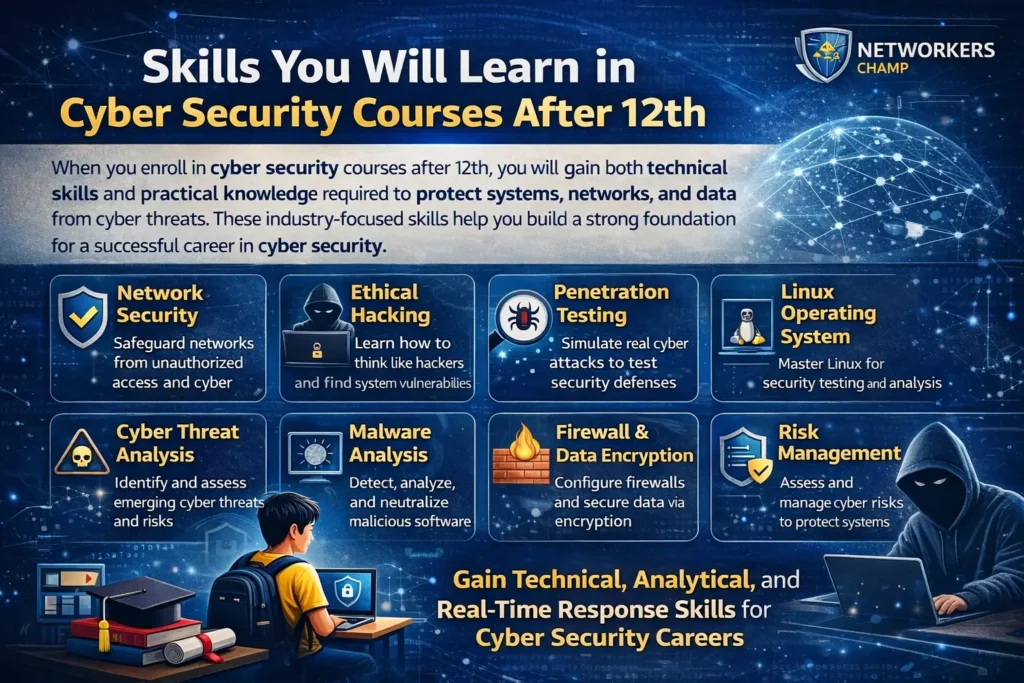
When you join cyber security courses after 12th, you will learn both practical skills and technical knowledge to protect systems, networks, and data from cyber attacks. These skills help you build a strong base for a successful career in cyber security.
First, you will understand network security basics. You will learn how data moves across networks and how to keep it safe from hackers. Then, you will explore ethical hacking, where you learn how hackers think and how to find system weaknesses before they are misused.
You will also practice penetration testing, which means testing systems by simulating real cyber attacks. Along with this, you will get hands-on experience with the Linux operating system, which is widely used in cyber security.
The course also teaches threat analysis, malware detection, and risk management. These skills help you find, stop, and fix security problems quickly. You will also learn firewalls, data encryption, and cloud security, which are important for protecting online data.
By the end, you will improve your problem-solving and analytical skills, making you ready for jobs like cyber security analyst, ethical hacker, or security engineer.
Conclusion: The Future of Cyber Security
As technology continues to advance, the demand for skilled cybersecurity professionals is only set to increase. With a variety of cyber security courses after 12th to choose from, students have plenty of options to start their career in this growing field. Whether you choose a full degree, a diploma, or an online course, each path offers opportunities to gain the skills needed to succeed.
In a world where cyber threats are constantly evolving, having the right knowledge and expertise can make all the difference. By choosing a cybersecurity course after 12th, you’re not just preparing for a job; you’re stepping into a vital role that will help protect the digital future. So, start your journey today and take advantage of the numerous opportunities in cyber security.
Frequently Asked Questions About Cyber Security Courses After 12th
1. Which course is best for cyber security after 12th?
It depends on your stream and how quickly you want to start working. B.Tech in Cyber Security suits PCM students aiming at long-term engineering roles. BCA Cyber Security works for any stream and costs far less. If you want a job within a year, a CCNA plus CEH certification path is the fastest route and is open to every stream.
2. What is the fees for cyber security courses after 12th in India?
Degree programs range from ₹1.5 lakh to ₹16 lakh depending on the college and course. Diplomas cost between ₹40,000 and ₹1.5 lakh. Certification courses such as CEH or CompTIA Security+ range from ₹25,000 to ₹90,000. In Bangalore, a full networking plus security combo program typically falls between ₹50,000 and ₹1.2 lakh.
3. Can I do cyber security after 12th without mathematics?
Yes. BCA Cyber Security, B.Sc Cyber Security at many colleges, diploma programs, and all certification courses accept students without PCM. Only B.Tech strictly requires Physics, Chemistry and Mathematics. Entry-level cyber security work needs logical thinking and networking understanding, not advanced mathematics.
4. Can a commerce or arts student do cyber security?
Yes. Commerce and arts students can join BCA Cyber Security, diploma programs, or certification tracks like CCNA and CEH. Commerce backgrounds are especially useful in compliance, audit and risk management roles at banks and fintech companies. Cyber security hiring focuses on demonstrated practical skill rather than your 12th stream.
5. What is the salary for cyber security freshers in India?
Freshers typically start between ₹3 and ₹6 lakh per year depending on the role and certifications held. Bangalore packages run about 15 to 20 percent above the national average. With 3 to 5 years of experience, salaries commonly reach ₹10 to ₹18 lakh per year, and senior architects cross ₹40 lakh.
6. Is CCNA required before learning cyber security?
CCNA is not mandatory but is strongly recommended. Cyber security is built on networking fundamentals – firewalls, intrusion detection and penetration testing all assume you understand routing, switching and TCP/IP. Students who complete CCNA first learn security tools much faster and perform noticeably better in technical interviews.
7. Do I need coding knowledge for cyber security?
Basic coding helps but is not required to start. Most entry-level roles need Linux command line comfort and an awareness of scripting. Python becomes genuinely useful at intermediate level for automation and penetration testing. You can begin cyber security training with zero programming background.
8. How long does it take to get a cyber security job after 12th?
Through the certification path, 6 to 12 months of focused training with consistent lab practice can lead to an entry-level SOC analyst or network security role. Through the degree path it takes 3 to 4 years, but usually starts at a higher package and opens more long-term options.
9. Which is better after 12th, cyber security or data science?
Cyber security has a lower entry barrier and does not require heavy mathematics, while data science needs strong statistics and mathematics. Both have solid demand in Bangalore. Choose cyber security if you prefer networks, systems and defence work. Choose data science if you enjoy working with data patterns and analytics.
10. Are there cyber security courses in Bangalore after 12th?
Yes. Bangalore has the largest cyber security job market in India, with training institutes across Marathahalli, Whitefield, Electronic City and BTM Layout. NetworkersChamp offers CCIE-led networking and cyber security training on Marathahalli Ring Road with real device lab access and 24/7 rack availability.
11. Can I learn cyber security online after 12th?
Yes. Instructor-led online batches with live remote lab access deliver the same outcome as classroom training. Recorded-only video courses are cheaper but have very low completion rates and rarely include lab access, so choose live training with real equipment wherever possible.
12. Is cyber security a good career in India in 2026?
Yes. India continues to face a significant shortage of trained cyber security professionals across banking, IT services, healthcare, manufacturing and government sectors. Demand for SOC analysts, cloud security specialists and network security engineers keeps rising, and salaries have grown steadily year on year.