
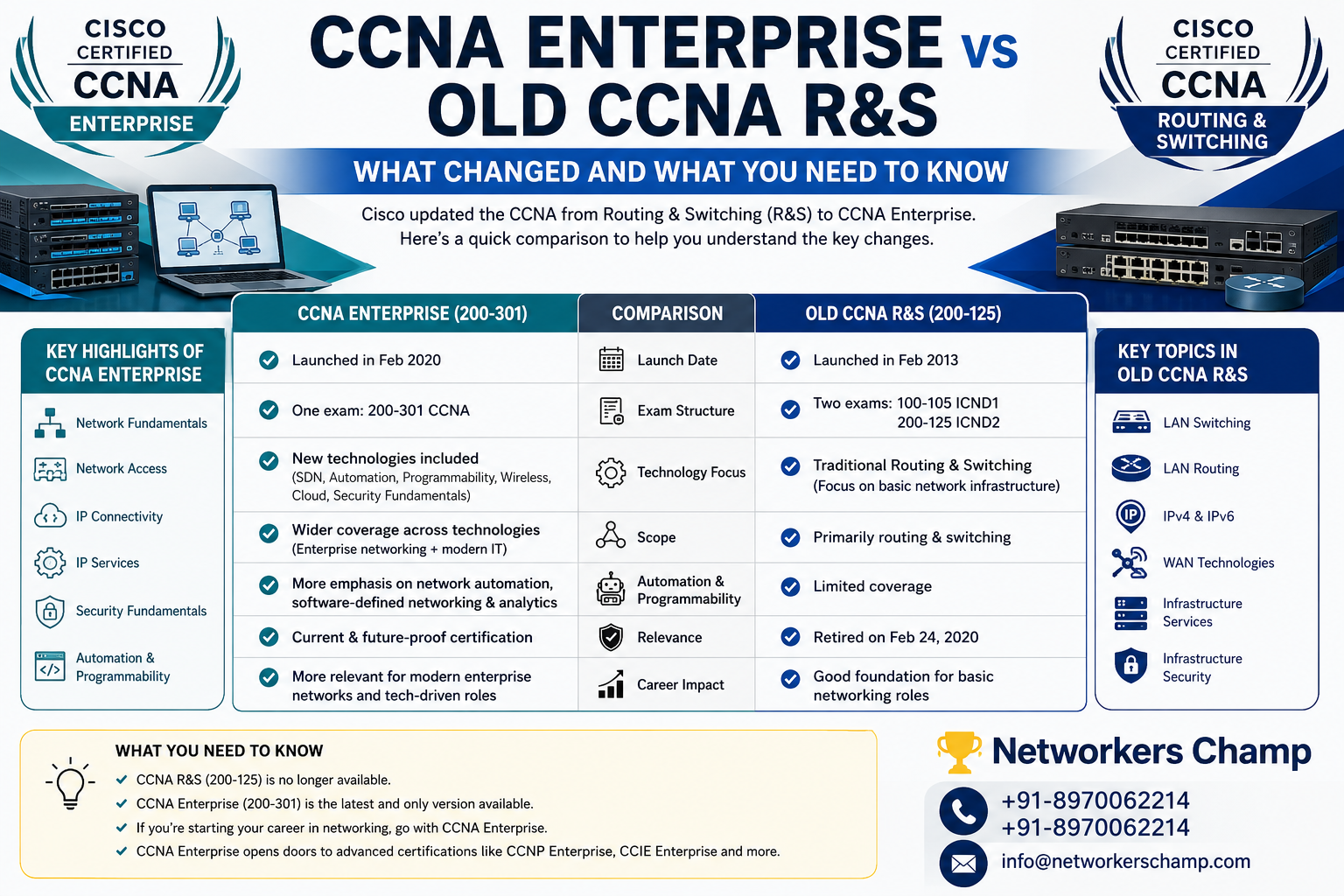
CCNA enterprise vs old CCNA difference is an important topic for students, freshers, and networking professionals who are confused between the old CCNA Routing & Switching certification and the current CCNA path. Many learners still hear terms like “CCNA R&S,” “CCNA Enterprise,” and “CCNA 200-301,” but they do not always understand what changed after Cisco updated its certification structure. At Networkers Champ, Marathahalli Bangalore, students are trained on the current Cisco CCNA syllabus with practical lab exposure, real Cisco rack practice, and career-focused networking guidance.
The simple answer is this: old CCNA Routing & Switching was mainly focused on traditional routing and switching skills, while the current CCNA covers a broader set of modern networking fundamentals, including security basics, wireless, automation, programmability, and enterprise networking concepts. This makes the current CCNA more relevant for 2026 networking jobs.
What Was the Old CCNA Routing & Switching?
The old CCNA Routing & Switching, often called CCNA R&S, was one of Cisco’s most popular certifications for networking beginners. It focused heavily on routing, switching, IP addressing, VLANs, subnetting, WAN technologies, and network troubleshooting.
Before Cisco changed the certification structure, candidates could prepare for CCNA Routing & Switching through different exam routes. Some students took a single CCNA exam, while others completed ICND1 and ICND2 exams. The course was very strong for building classic networking fundamentals.
Old CCNA R&S mainly covered:
- Networking basics
- OSI and TCP/IP models
- IPv4 and IPv6 addressing
- Subnetting
- Switching concepts
- VLANs and trunking
- Spanning Tree Protocol
- Static routing
- Dynamic routing protocols
- WAN technologies
- ACLs
- NAT
- Basic troubleshooting
This certification was useful for roles like Network Support Engineer, NOC Engineer, Junior Network Engineer, and IT Support Engineer. However, the networking industry changed. Modern networks are no longer only about routers and switches. Companies now expect candidates to understand security, wireless, cloud connectivity, automation, software-defined networking, and network programmability basics.
That is why Cisco replaced the old structure with the current CCNA certification path.
What Is the Current CCNA Enterprise / CCNA 200-301?
The current CCNA certification is based on the 200-301 CCNA exam. Many institutes and learners call it “CCNA Enterprise” because it is connected to enterprise networking and acts as the foundation for CCNP Enterprise and advanced Cisco career paths. However, the official certification name is simply CCNA.
This current CCNA is broader than the old CCNA R&S. It still includes routing and switching, but it also adds modern topics that are important in today’s IT environment.
Current CCNA includes:
- Network fundamentals
- Network access
- IP connectivity
- IP services
- Security fundamentals
- Automation and programmability
This means students are no longer trained only for traditional routing and switching. They also learn concepts linked to modern enterprise networks, cloud-connected networks, automation, and secure infrastructure.
For 2026, this matters a lot. A fresher who only knows old-style routing and switching may struggle in interviews where companies ask about wireless, security basics, automation, APIs, controllers, and cloud-era networking.
CCNA Enterprise vs Old CCNA Difference — Main Comparison
| Point | Old CCNA Routing & Switching | Current CCNA / CCNA Enterprise |
|---|---|---|
| Certification Name | CCNA Routing & Switching | CCNA |
| Exam Style | Old exam structure with R&S focus | Single 200-301 CCNA exam |
| Main Focus | Routing, switching, subnetting, WAN | Networking, security, wireless, automation |
| Security Coverage | Basic | More important than before |
| Wireless Coverage | Limited | Included as part of network access |
| Automation | Not a major topic | Included |
| Programmability | Almost no focus | Basic concepts included |
| Best For | Traditional network support roles | Modern network, cloud, security, and infrastructure roles |
| Career Path | CCNP R&S, CCIE R&S | CCNP Enterprise, Security, Cloud, Automation paths |
| Relevance in 2026 | Outdated as certification path | Current and job-relevant |
The biggest difference is not that routing and switching disappeared. They are still important. The difference is that the current CCNA expects students to understand networking in a wider business and technology environment.
What Changed in the Syllabus?
The old CCNA R&S was deep in classic routing and switching. The current CCNA still respects those basics, but Cisco reduced some older-heavy topics and added modern ones.
1. Automation and Programmability Added
This is one of the biggest changes. Students now need to understand basic automation concepts, controller-based networking, APIs, and how networks are managed in modern environments.
You do not need to become a Python developer for CCNA. But you should understand how automation is changing network operations.
2. Security Became More Important
Earlier, security was present but not as strongly connected to the CCNA path. Now security fundamentals are part of the core CCNA syllabus.
Students must understand:
- Device security basics
- Password protection
- Secure remote access
- Basic firewall concepts
- Access control
- Security threats
- Wireless security basics
This is useful because many networking jobs now overlap with security operations.
3. Wireless Is More Relevant
Modern offices, campuses, hospitals, schools, hotels, and enterprises depend heavily on wireless networks. The current CCNA includes wireless concepts so students are not limited to wired networks only.
4. One Main CCNA Exam Path
The old structure had multiple associate-level certifications such as CCNA Routing & Switching, CCNA Security, CCNA Wireless, CCNA Collaboration, and more. The newer model simplified this at the associate level. Now CCNA gives a broader foundation before students specialize later.
5. More Career Flexibility
Old CCNA R&S mainly pointed toward routing and switching careers. Current CCNA gives students flexibility to move toward:
- CCNP Enterprise
- Network security
- Firewall administration
- Cloud networking
- Data center networking
- Wireless networking
- Network automation
- Cybersecurity basics
This makes the current CCNA more useful for students who are still deciding their career path.
Is Old CCNA R&S Still Valid?
The old CCNA Routing & Switching exam path is retired. That means new students cannot take the old CCNA R&S exam anymore. If someone earned the old certification earlier, it may have helped them at that time, but for new learners in 2026, the correct path is the current CCNA 200-301.
Students should not waste time searching for outdated CCNA R&S dumps, old exam blueprints, or old course PDFs. Some old topics are still useful, especially subnetting, VLANs, routing, switching, and troubleshooting. But your preparation should follow the current CCNA syllabus.
The better approach is:
- Learn routing and switching strongly
- Add security fundamentals
- Learn wireless basics
- Understand automation concepts
- Practice with labs
- Prepare for modern interview questions
Which One Is Better for Jobs in 2026?
The current CCNA is better for jobs in 2026 because it matches today’s networking industry better than old CCNA R&S.
Companies now want networking candidates who can understand:
- LAN and WAN basics
- Routing and switching
- IP services
- Network security
- Wireless networks
- Cloud-connected infrastructure
- Monitoring and troubleshooting
- Basic automation concepts
A candidate who only says “I know routing and switching” may not stand out. A candidate who understands practical networking plus security and automation basics has a stronger profile.
Common job roles after current CCNA include:
- Network Support Engineer
- NOC Engineer
- Junior Network Engineer
- IT Infrastructure Engineer
- Technical Support Engineer
- Network Administrator
- Cloud Network Support Associate
- Network Security Trainee
For freshers, CCNA is still one of the best starting points. But the certificate alone is not enough. Lab practice is what turns CCNA knowledge into job confidence.
Lab Practice Needed for Current CCNA
A strong CCNA course should include practical labs, not only theory classes.
Students should practice:
- IP addressing and subnetting
- VLAN configuration
- Trunking
- Inter-VLAN routing
- Static routing
- OSPF basics
- NAT and PAT
- ACL configuration
- DHCP and DNS concepts
- Wireless basics
- Device security
- Troubleshooting commands
- Network verification
- Packet Tracer labs
- Real Cisco router and switch practice
This is where many cheap CCNA courses fail. They teach slides but do not build troubleshooting confidence. In interviews, companies often test whether you can explain what happens when a network fails. That skill comes only from practice.
Why Networkers Champ for Current CCNA Training?
Networkers Champ in Marathahalli Bangalore is a strong choice for students who want to learn current CCNA with a practical Cisco-focused approach. The institute highlights training under a CCIE #34942 trainer, real Cisco rack exposure, foreign student support, and recognition from Times Cyber Media as a No.1 networking institute.
The advantage of learning CCNA at Networkers Champ is that the training is not limited to exam theory. Students can build practical understanding of routing, switching, troubleshooting, enterprise networking, and career interview preparation. For learners who want to grow further, CCNA can become the foundation for CCNP, CCIE, network security, and cloud networking paths.
Networkers Champ is especially suitable for:
- Freshers starting a networking career
- Working professionals shifting into networking
- Students planning CCNP or CCIE later
- International students looking for Cisco training in Bangalore
- Candidates who want real Cisco lab practice
- Learners who need placement-focused support
FAQ — CCNA Enterprise vs Old CCNA Difference
What is the main CCNA enterprise vs old CCNA difference?
The main difference is that old CCNA R&S focused mostly on routing and switching, while the current CCNA includes routing, switching, security, wireless, automation, and programmability basics.
Is CCNA Routing & Switching still available?
No, the old CCNA Routing & Switching exam path has been retired. New students should prepare for the current 200-301 CCNA exam.
Is CCNA Enterprise the official certification name?
The official certification name is CCNA. Many institutes use “CCNA Enterprise” because the course connects to enterprise networking and future CCNP Enterprise learning.
Is current CCNA harder than old CCNA R&S?
It is broader, not necessarily harder. Students need to study more types of topics, including security, wireless, and automation basics.
Do I still need to learn routing and switching?
Yes. Routing and switching are still core parts of CCNA. The new syllabus adds more topics but does not remove networking fundamentals.
Which CCNA is best for freshers in 2026?
Freshers should prepare for the current CCNA 200-301 because it is the active Cisco certification path.
Does current CCNA help in cybersecurity?
Yes. CCNA builds networking and security fundamentals, which are useful for cybersecurity, firewall, SOC, and network security roles.
How long does CCNA training take?
Most CCNA training programs take around 6 weeks to 3 months depending on batch timing, lab practice, and student background.
Does Networkers Champ provide CCNA lab training?
Yes, Networkers Champ provides Cisco-focused CCNA training with practical lab exposure and real Cisco rack-based learning.
What should I do after CCNA?
After CCNA, students can move toward CCNP Enterprise, CCNP Security, firewall training, cloud networking, cybersecurity, or CCIE depending on their career goal.
Conclusion
The CCNA enterprise vs old CCNA difference is simple: old CCNA R&S was mainly focused on traditional routing and switching, while the current CCNA prepares students for modern enterprise networking. It includes routing, switching, security, wireless, automation, and programmability basics.
For 2026, students should not follow outdated CCNA R&S material alone. Learn the current CCNA 200-301 syllabus, practice real labs, and build troubleshooting confidence.