
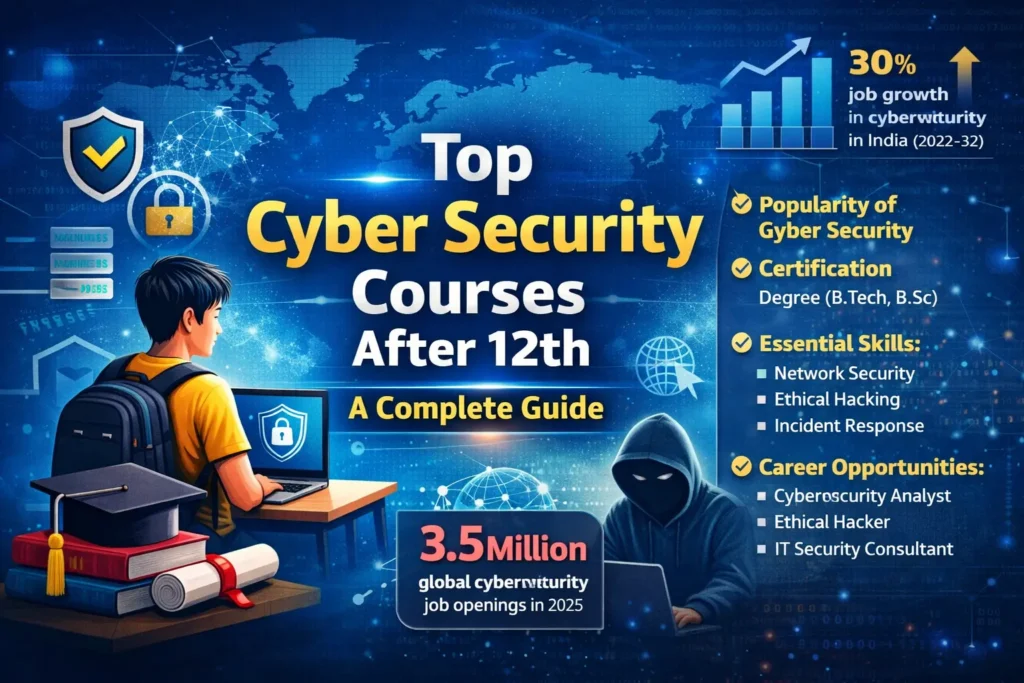
Cyber Security Courses After 12th: Complete Career Guide for Students
In today’s digital age, the importance of cybersecurity has skyrocketed. With increasing threats to personal, corporate, and government data, there is a growing demand for professionals who can safeguard sensitive information. This makes cybersecurity one of the most promising and lucrative career paths for students after completing 12th grade. If you’re considering a career in this field, this guide will take you through the top cyber security courses after 12th, offering a detailed breakdown of what to expect, the eligibility criteria, and career opportunities.
What is Cyber Security?
Cybersecurity involves protecting computer systems, networks, and data from digital attacks, theft, and other threats. The goal is to ensure that information remains safe and accessible only to authorized users. As the digital world grows, the need for skilled professionals to manage these security protocols becomes even more crucial.
Why Choose Cyber Security After 12th?
Cybersecurity offers various career benefits:
- High Demand for Professionals: As the frequency and severity of cyberattacks increase, companies are seeking experts who can protect their networks and data.
- Lucrative Salaries: Cybersecurity professionals are well-compensated, with salaries that grow as you gain experience and specialization.
- Job Security: With the ever-increasing reliance on digital platforms, cybersecurity is an area where job growth is expected to remain steady for years.
- Diverse Career Opportunities: From ethical hacking to network security, there are several paths you can take within the field.
Now, let’s look at the top cyber security courses after 12th that can help you kickstart your career in this exciting and fast-growing field.
1. B.Tech in Cyber Security
Eligibility: 10+2 with Physics, Chemistry, and Mathematics (PCM)
A B.Tech in Cyber Security is one of the most comprehensive courses you can pursue after 12th if you’re interested in a long-term career in this field. This degree will not only introduce you to the fundamentals of cybersecurity but also provide you with advanced knowledge of networking, cryptography, information security management, and ethical hacking.
Key Subjects Covered: Network security, cryptography, security audits, ethical hacking, and data protection.
Career Opportunities: Network Security Engineer, Information Security Analyst, Ethical Hacker, Cyber Security Consultant.
2. BCA (Bachelor of Computer Applications) with Cyber Security Specialization
Duration: 3 years
In addition, for students who want to enter the world of IT and cybersecurity but prefer a more flexible degree, a BCA with a cybersecurity specialization can be an ideal choice.
The course focuses on programming, computer networks, database management, and cyber law, with specialized subjects related to cyber threats, vulnerabilities, and secure coding.
Key Subjects Covered: Programming, Database management, Networking, and Cyber Law.
Career Opportunities: Cyber Security Analyst, IT Manager, Network Administrator, System Security Manager.
3. Diploma in Cyber Security
Duration: 1-2 years
Eligibility: 10+2
For students who prefer a shorter, more focused course, a Diploma in Cyber Security is an excellent option. This course provides practical training on handling security issues like hacking, malware, and data theft, without the extensive commitment of a full degree. Many technical institutes and universities offer this diploma, which can be a stepping stone to more advanced studies or immediate job placements.
Key Subjects Covered: Network security, Ethical Hacking, Web Security, and Cyber Forensics.
Career Opportunities: Security Analyst, IT Support, Cyber Security Consultant.
4. Certified Ethical Hacking (CEH)
Duration: 3-6 months
Eligibility: No formal degree required, but prior knowledge of networking is recommended.
For those looking to specialize in ethical hacking, the Certified Ethical Hacking (CEH) course is one of the most recognized certifications worldwide. It covers the methods used by hackers to infiltrate systems, which helps security professionals learn how to defend against such attacks.
Key Subjects Covered: Footprinting, network scanning, malware threats, hacking web servers, and penetration testing.
Career Opportunities: Ethical Hacker, Penetration Tester, Security Consultant, Cyber Crime Investigator.
5. B.Sc. in Cyber Security
Duration: 3 years
Eligibility: 10+2 with Science (preferably Physics, Chemistry, and Mathematics)
For students who prefer a scientific approach to cybersecurity, a B.Sc. in Cyber Security is an excellent option. The course covers various aspects of IT security, including the technical, legal, and administrative components required to protect digital infrastructure.
Key Subjects Covered: Cyber Laws, Risk Management, Malware Analysis, and Information Security.
Career Opportunities: Cyber Security Engineer, Information Security Analyst, Risk Management Consultant.
6. M.Sc. in Cyber Security (For Postgraduates)
Duration: 2 years
Eligibility: Graduation in a related field (BCA, B.Tech, etc.)
If you already have a basic understanding of IT or cybersecurity and want to take your knowledge to the next level, pursuing an M.Sc. in Cyber Security can be a good option. This course is designed to build expertise in areas like advanced encryption techniques, network monitoring, and cloud security.
Key Subjects Covered: Advanced Cryptography, Secure Software Development, Cloud Security, and Risk Management.
Career Opportunities: Cyber Security Researcher, Security Architect, Network Security Administrator.
BCA Cyber Security vs B.Tech Cyber Security
| Feature | BCA Cyber Security | B.Tech Cyber Security |
| Duration | 3 Years | 4 Years |
| Focus | Software & Applications | Engineering & Infrastructure |
| Technical Depth | Moderate | Advanced |
| Best For | IT & software careers | Advanced security engineering |
| Eligibility | Any stream in many colleges | PCM compulsory |
| Career Roles | Analyst, Admin | Engineer, Security Architect |
Which One is Better?
- Choose BCA Cyber Security if you prefer software applications, coding, and IT management.
- Choose B.Tech Cyber Security if you want deeper technical knowledge and engineering-focused career roles.
Ethical Hacking vs Cyber Security
| Ethical Hacking | Cyber Security |
| Focuses on finding vulnerabilities | Focuses on complete protection |
| Offensive approach | Defensive + offensive approach |
| Includes penetration testing | Covers networks, cloud, applications, and systems |
| Specialized field | Broad industry domain |
Main Difference
Ethical hacking is a part of cyber security. Cyber security includes multiple areas like cloud security, digital forensics, compliance, incident response, and threat analysis.
Diploma vs Degree in Cyber Security
| Diploma | Degree |
| Short-term course | Long-term academic program |
| Faster job entry | Better career growth |
| Practical-focused | Theory + practical learning |
| Lower cost | Higher investment |
| Suitable for beginners | Suitable for advanced career goals |
Which Should You Choose?
- A diploma is good for skill-based quick learning.
- A degree offers stronger long-term career opportunities and higher-level roles.
7. Online Cyber Security Courses
Duration: Varies (from a few weeks to a year)
Additionally, many online platforms, such as Coursera, Udemy, and edX, offer cyber security courses that can be taken from the comfort of your home. These courses are perfect for those looking to learn at their own pace, whether it’s a general introduction to cyber security or a specialized course in ethical hacking or network defense.
Key Subjects Covered: Basic Cyber Security, Ethical Hacking, Malware Analysis, and Digital Forensics.
Career Opportunities: Cyber Security Specialist, Network Security Engineer, Information Security Consultant.
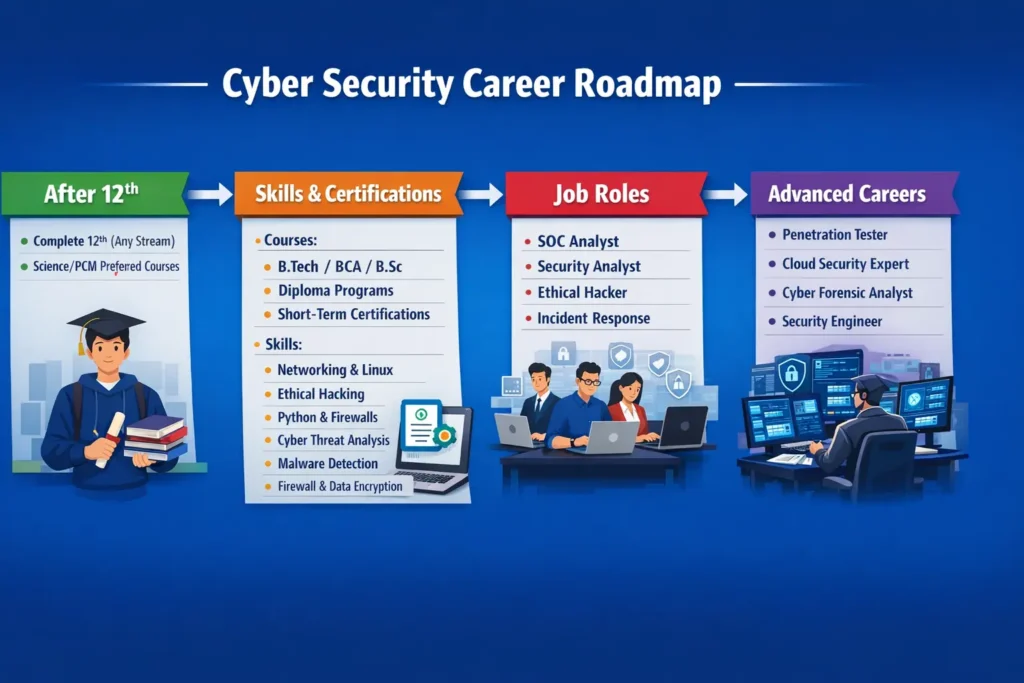
Cyber security career roadmap after 12th
Tools You Will Learn
In cyber security courses after 12th, you will work with powerful industry tools used in ethical hacking, network security, and penetration testing. These tools help you gain real-time experience in identifying and preventing cyber threats.
- Nmap (Network Scanner): Learn network scanning and detect open ports, devices, and vulnerabilities.
- Wireshark: Perform packet analysis to monitor network traffic and identify suspicious activities.
- Metasploit: Practice penetration testing by simulating real cyber attacks safely.
- Burp Suite: Test web application security and find issues like XSS and SQL injection.
- Kali Linux: Use a complete platform for ethical hacking and security testing.
- Nessus: Conduct vulnerability assessment to find system weaknesses.
- SIEM Tools: Monitor logs and enable real-time threat detection and incident response.
These tools build your practical skills and prepare you for real-world cyber security roles.
Skills You Will Learn
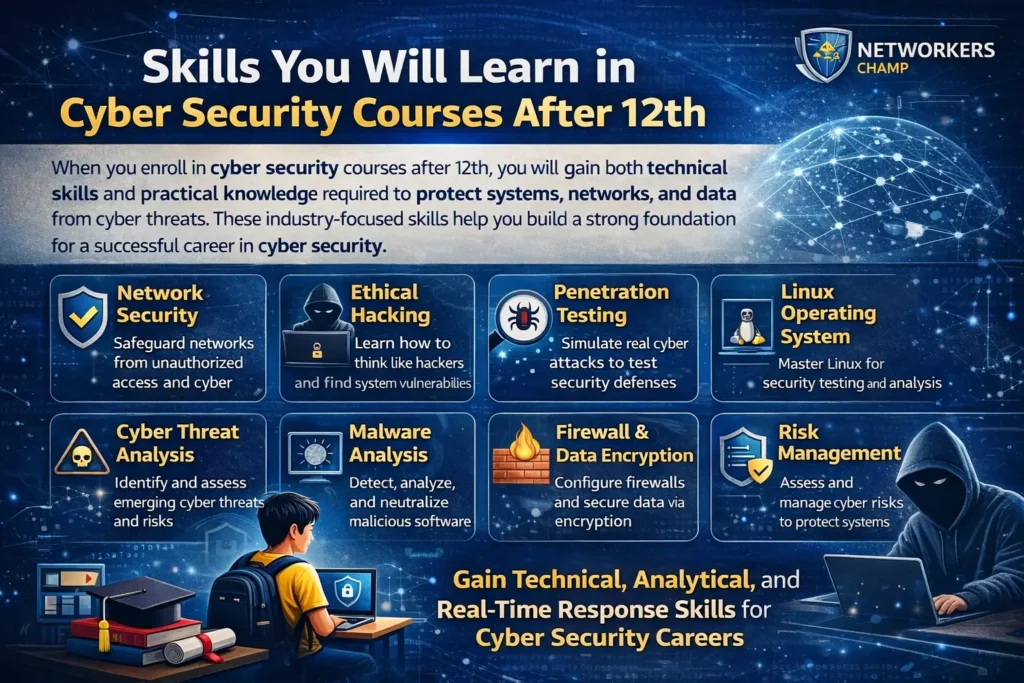
When you join cyber security courses after 12th, you will learn both practical skills and technical knowledge to protect systems, networks, and data from cyber attacks. These skills help you build a strong base for a successful career in cyber security.
First, you will understand network security basics. You will learn how data moves across networks and how to keep it safe from hackers. Then, you will explore ethical hacking, where you learn how hackers think and how to find system weaknesses before they are misused.
You will also practice penetration testing, which means testing systems by simulating real cyber attacks. Along with this, you will get hands-on experience with the Linux operating system, which is widely used in cyber security.
The course also teaches threat analysis, malware detection, and risk management. These skills help you find, stop, and fix security problems quickly. You will also learn firewalls, data encryption, and cloud security, which are important for protecting online data.
By the end, you will improve your problem-solving and analytical skills, making you ready for jobs like cyber security analyst, ethical hacker, or security engineer.
Conclusion: The Future of Cyber Security
As technology continues to advance, the demand for skilled cybersecurity professionals is only set to increase. With a variety of cyber security courses after 12th to choose from, students have plenty of options to start their career in this growing field. Whether you choose a full degree, a diploma, or an online course, each path offers opportunities to gain the skills needed to succeed.
In a world where cyber threats are constantly evolving, having the right knowledge and expertise can make all the difference. By choosing a cybersecurity course after 12th, you’re not just preparing for a job; you’re stepping into a vital role that will help protect the digital future. So, start your journey today and take advantage of the numerous opportunities in cyber security.
FAQs About Cyber Security Courses After 12th
1. Which course is best for cyber security after 12th?
B.Tech in Cyber Security, BCA Cyber Security, and CEH certifications are among the best options depending on your career goals.
2. Can I join cyber security without mathematics?
Yes, some diploma and BCA programs allow students without PCM backgrounds.
3. Is cyber security a good career in India?
Yes, cyber security is one of the fastest-growing career fields in India with increasing demand across industries.
4. What is the average salary in cyber security?
Freshers can start with decent packages, and salaries grow significantly with certifications and experience.
5. Which is better: ethical hacking or cyber security?
Ethical hacking is a specialization inside cyber security. Cyber security offers broader career opportunities.
6. Can I learn cyber security online after 12th?
Yes, many online platforms offer beginner-friendly cyber security and ethical hacking courses.